Restructuring Acadia: A Revision
On April 6, 2026, Jeff Hennessy (President and Vice-Chancellor) and Ashlee Cunsolo (Provost and Vice President Academic) announced proposed changes which would vastly change how academic programs are structured at Acadia. Shortly after this proposal was emailed to students, I published my analysis to try and help break down the 13 pages that explained what (Re)Building Acadia would mean. Many parts of their proposal were considered controversial by members of the Acadia community, most notably being the elimination of departments and schools alongside the reduction of three faculties into two ‘colleges’. Since then, Acadia has offered a series of information sessions for both students and faculty to help gather feedback and answer questions regarding this proposed plan. Yesterday, April 21, Acadia released a second proposal which introduces several changes, alongside some more insight into what they learned from the gathered feedback.
The New Proposal
The new proposal ditches the previously proposed ‘two college’ model, instead in favour of a single ‘Faculty of Acadia University’. The April 21 letter to the Acadia community acknowledges that the collegial model “has merit and opens intriguing possibilities” but recognizes the short timelines “do not allow the idea to be fully conceptualized”. The letter continues by saying that a single faculty structure will be “more cost-effective, sustainable, streamlined, nimble, and responsive”, while also dividing resources more equitably. Additionally, the proposed faculty will include eight schools, which will contain clusters of similar programs. Each school would be led by a director and are envisioned to have at least two academic administrative assistants.
Proposed Schools
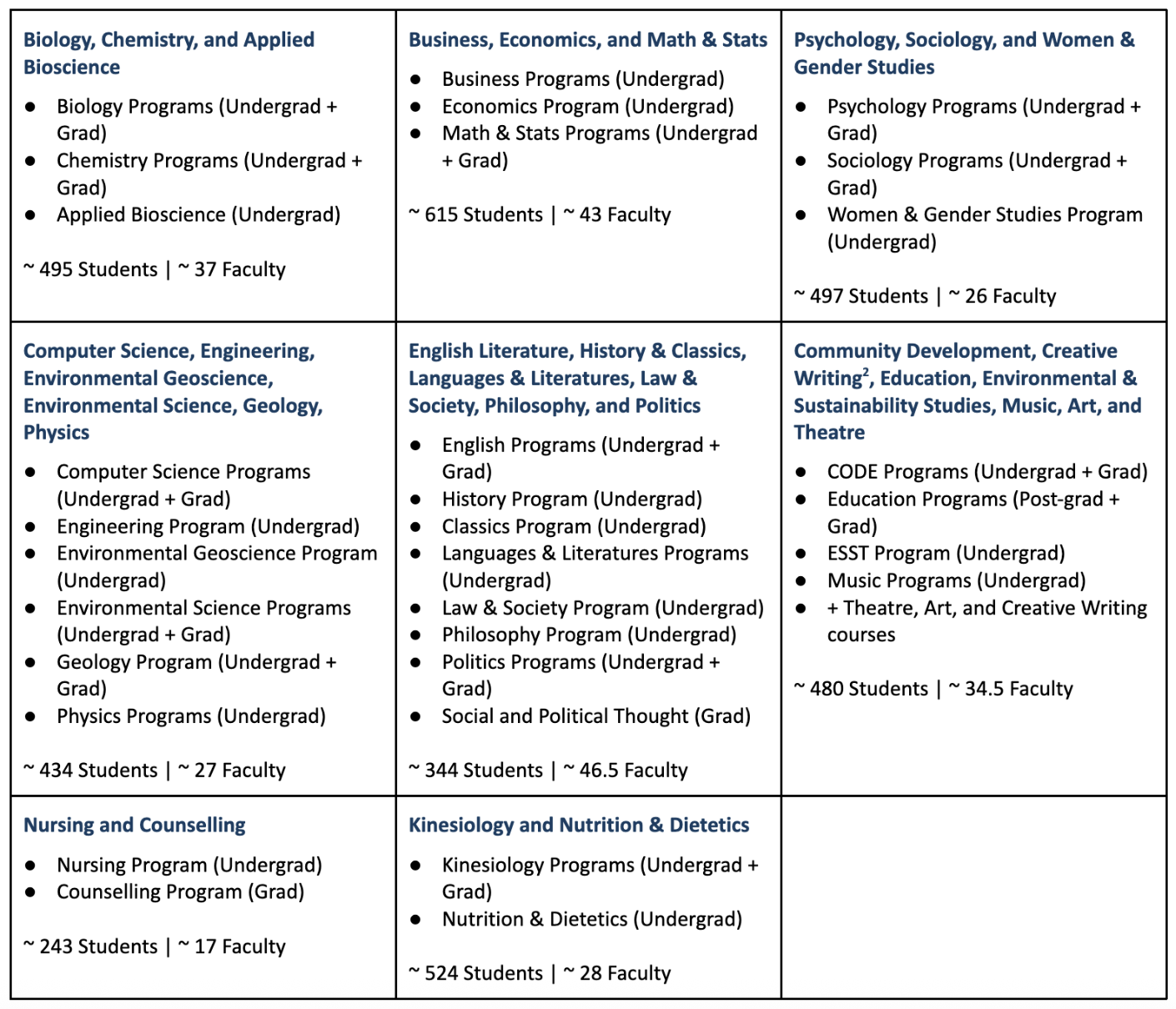
1 Student numbers are from December 1, 2025; Faculty numbers were pulled on March 31, 2026, and include all faculty/instructors in each program/unit at that time.
2 This would necessitate redeploying Creative Writing faculty members out of the rest of the English program, but only with their consent and interest.
(Adapted from Dear Acadia Community [April 21], page 4)
Balanced Structure
An argument for introducing eight schools is that it will provide a more balanced campus in terms of resources compared to the previous department system. An excellent example of this is the current ratio of administrative assistants to students by department. Under the current structure at Acadia, there is often a single administrative assistant in charge of an academic unit (It should be noted that some larger units already have multiple administrative assistants, and other smaller ones share one across a cluster of programs).
For smaller departments, having a single administrative assistant often works great. In larger departments, however, the same position is responsible for a much bigger workload. Acadia’s new proposal is more evenly distributed, as the proposed schools have similar enrollment and faculty numbers. I do speculate that this rebalance will likely end up being more beneficial to larger programs than it will to smaller ones. Since programs are being combined, it is inevitable that some administrative assistants will become responsible for more duties, and others will receive much needed support. Overall, this is probably an excellent way of saving money as they can increase coverage across programs without having to hire more staff.
School Councils & Program Committees
The revised proposal also mentions School Councils and Program Committees. Since the letter pretty well summed up both of these, I’ve quoted their paragraph directly:
Each School will have a School Council, responsible for academic decision-making at the School level. Each program within the Schools can create and operate a Program Committee, which will be responsible for the curricular and academic decisions related to each program, feeding up to the School Council. (Dear Acadia Community [April 21], page 6)
Familiarity
What is notable about this proposal is that the titles used are familiar to those in the current organizational structure at Acadia. The previous proposal contained a lot of jargon, and the use of the term ‘college’ was considered confusing by many students. This concern regarding the term ‘college’ was actually acknowledged in the April 21 letter to students. The letter blames concern from a “lack of understanding in Nova Scotia of the difference between a university college and a community college”. Although I personally agree with the statement that many students did not know the difference between the two types of colleges, I also think Acadia University is partially at fault. In the initial letter to the Acadia community, they should have clearly defined ‘university college’ since this is a completely new concept in the region. Placing blame on a “lack of understanding” is not enough if students don’t have the context to ‘understand’ correctly.
Another smart choice was to revive the title of ‘Director’ for the individual responsible for schools. In the previous proposal, there were several changes to the names of positions for the academic units, specifically the introduction of the ‘Associate Dean’ position. In the updated proposal, there were a multitude of reasons why this was walked back (i.e., feedback from departments & schools, concerns with AUFA contract). It also helps that the title of “Director” is already used across campus, both in academic and non academic departments. Assuming the university moves forward with this proposal, things almost appear to look somewhat similar to the current model seen by Business, where there are several programs under one Director (e.g., Marketing, Accounting, Finance). I’ve attached the proposed governing structure below for reference.
Proposed Governing Structure
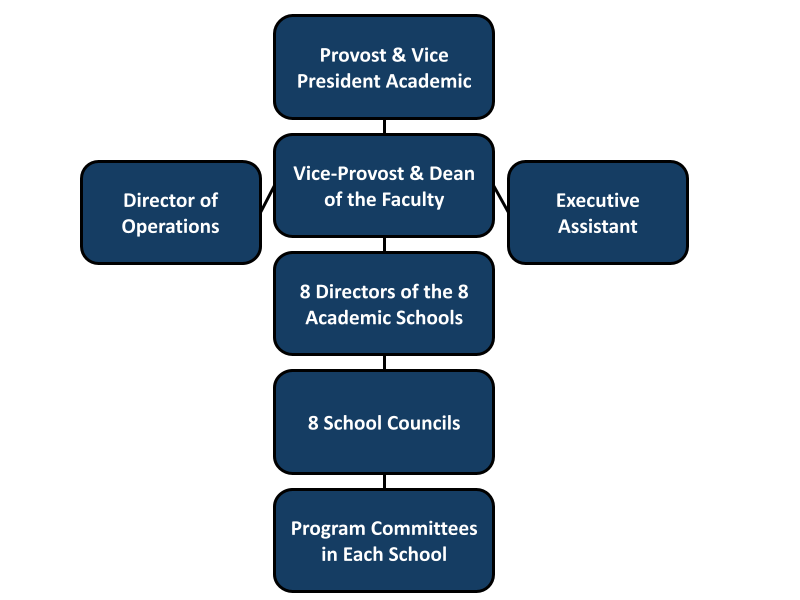
(Adapted from Dear Acadia Community [April 21], page 5)
Important to Note
I also think a few more points which were acknowledged on the second page of the April 21 letter are important to note. I’ve listed the article of feedback in bold and included my commentary below
(2) Very few people like the proposed names of the Colleges
I don’t think I did a great job of expressing this in my initial article, but I had the feeling at the time that Acadia’s Senior Leadership Team was hoping for members of the Acadia community to suggest new ‘college’ names. This ended up being true. Based on my conversation with Ashlee Cunsolo at the April 13th Student Drop-In Session, her and Jeff Hennessy “went through a hundred names and none of them stuck.” Notice that this time around, the university did not release any proposed names. Instead, they will be working with each school to determine appropriate names. This should hopefully help retain some of the character and personality from the old academic units when the new school names are being developed.
(9) Some people were excited about the concept of creating two academic learning communities each with embedded Schools that support a common theme. Ideas emerged about naming these communities with respect to place and space and adopting Mi’kmaw names. Others found this idea confusing and even risky
Some context here, since this wasn’t documented in the previous emails to the Acadia Community, or my previous article. A suggested idea which was being floated around at the Student Drop-In sessions was to name the two colleges using Mi’kmaw names. Although not included in the initial proposal, the suggestion appeared to be gaining traction with a subset of the community. It sounds like this idea has since been scrapped.
(5) The embedded support model has widespread support, and there is excitement that we can break down silos and create a stronger sense of community among students, faculty, and staff – and that there is need for further clarity about roles, scope, responsibility, structure, etc. as stress around job loss and role change is high;
Another portion of my conversation with Cunsolo was in regards to the proposed embedded support model. My main concern at the time was what this new model would look like for Co-op, since Business has had an ‘in-house’ coordinator for some time. Cunsolo mentioned to me that this ‘in-house’ model had worked quite well for Business, and the new proposal was hoping to emulate parts of this across other student supports. If this model can be emulated effectively, I think it will be a huge benefit for students, as the individuals would be able to get to know their students and specialize in specific fields. We see this already with the subject librarians, which are assigned to specific programs and departments.
Another one of mine (and many other students’) concerns was how student services would look, considering the sweeping changes that were proposed. Common questions included “will [individual] continue to provide X service, or will I have to go see someone new?” or “I really like going to see [individual], are they being reassigned?” For what it’s worth, I wasn’t given an overly clear answer at the Student Drop-In Session (I assume there is much they can’t say right now and much they don’t know). The words “it would be their choice” were brought up a lot, which isn’t super clear to me what exactly that will mean. In the letter to the Acadia community, Hennessy and Cunsolo did state that “[they] will also continue to work on creating a more detailed staffing plan for the embedded support model”. This plan will integrate the feedback received and aims to clarify roles. According to the letter, this will “be released in the coming weeks.”
Conclusion
I think that the revised proposal for a restructure at Acadia is a much better fit for the students, faculty, and culture of the university than the first proposal was. By creating a single faculty with eight schools, I think that we hit a much better compromise which will aid the goals of making Acadia University more sustainable in the long term. HOWEVER, I do remain somewhat skeptical of what this will look like in the long term. Based on a hunch, I believe that the picture being painted for students is slightly more optimistic than the one being proposed behind the scenes and to the faculty/staff. I also know that a lot is still up for discussion and on the table, so if you have feedback, share it with them. Although their initial execution can sometimes be a bit rocky, I do honestly believe that Acadia’s senior leadership team are good at listening to students, and they try their hardest to get things right when they can. It’s for that reason that I remain ‘cautiously optimistic’ about what is to come.
As restructuring progresses, I will continue to cover developments. Regardless, I encourage you to check your emails and read all updates that are shared from our Senior Leadership Team. This restructure affects us all, and we are very fortunate for them to be as forthcoming and transparent with us as they have been.