Third time’s a charm? Acadia University's third restructuring proposal
On Wednesday, May 20, 2026, members of the Acadia community received a letter outlining a third proposal for restructuring academic programs and services. The letter was signed by Jeff Hennessy, President and Vice-Chancellor, Ashlee Cunsolo, Provost and VP Academic, along with the Vice Provosts, Deans and the Registrar. The newest proposal is a combination of the best of both proposals combined, with student and faculty feedback appearing to be the driving force behind the decisions made.
The New Proposal
The new model proposed by Acadia includes two Faculties which would be led by two Deans. Each Faculty would have a Manager of Operations, who would be responsible for “budget support, data and record keeping, building management, project management” (Page 5). Additionally, two Executive Assistants would be responsible for a “cross-trained team of administrative assistants and staff” (Page 5).
Inside the Faculties would be seven Schools. Schools would each be led by a Director (seven total) and eight Assistant Directors would be responsible for large or accredited programs, reporting to the Director. The new model would result in the reduction of 15 Academic Leadership positions, appearing to result from the reduction of Department Heads. The letter does acknowledge Administrative assistants, but does not mention how they might be distributed.
Proposal Three maintains the proposed introduction of School Councils, which would feed up to Faculty Councils, and then to the Senate. Additionally, “Critical Support Staff will continue to be linked to programs and centralized to each Faculty” (Page 6). This would include positions like placement leads and technicians. Beyond this, Acadia has yet to release a detailed plan for the new embedded support model.
Program Distribution
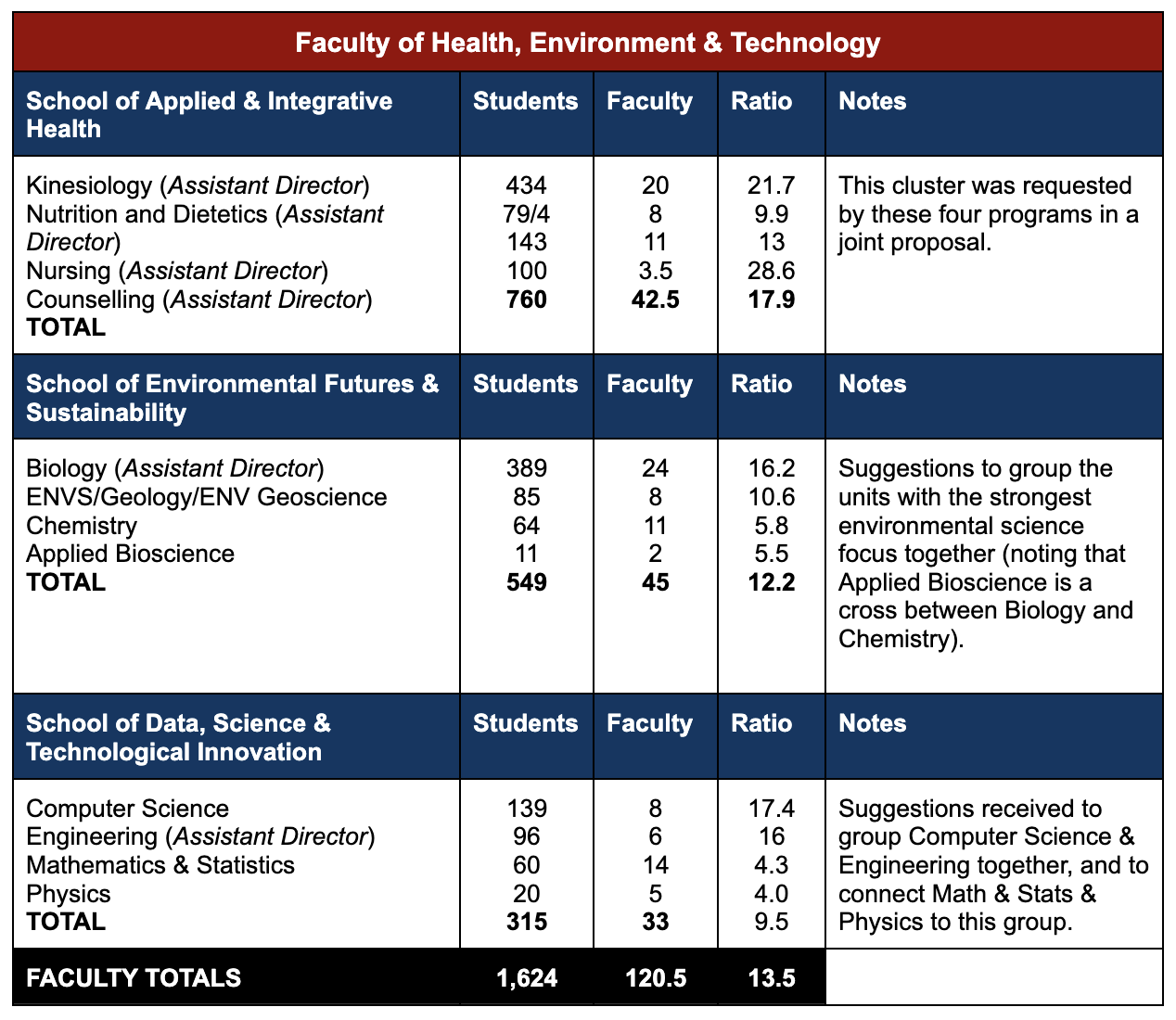
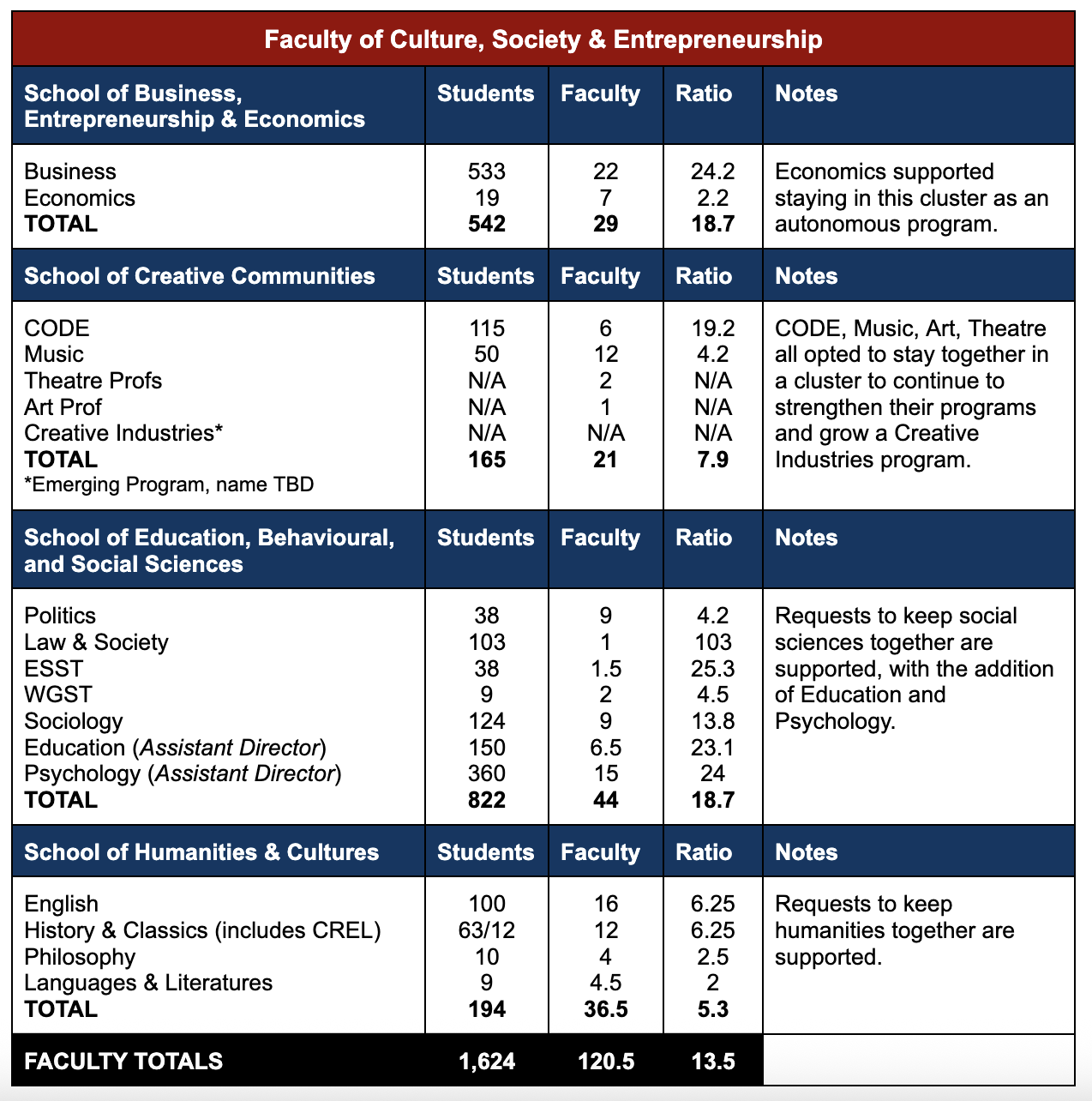
* Student numbers are from December 1, 2025, and include first majors only. Faculty numbers reflect full-time continuing faculty. CLTs and PCAs are not accounted. Some minor variations may apply to current numbers.
(Adapted from Dear Acadia Community [May 20], pages 3-4)
Timeline
The May 20 letter provides an adjusted timeline, proposed by the Science Heads/Directors. The letter also welcomes feedback submissions via email and states that Acadia will work with the ASU to reach out to students for feedback.
May 27: Special Meeting of Senate
This session will be for discussion only of Proposal 3 only, and not for a vote
June 17: Regular June Meeting of Senate
Acadia will bring Proposal 3 (likely with minor amendments from continued feedback) for Senate approval vote.
June 18-19: Board Retreat
Acadia will bring Proposal 3 (likely with minor amendments from continued feedback) to the Board for discussion only.
July: Special Board Meeting
Acadia will call a special meeting of the Board of Governors for final vote and approval.
August 30: Schedule H submission of institutional priorities and strategic plans
October 15: Final Schedule H submission
August 2026-June 2027: Preparing for Implementation
This includes working through all details related to budget, structure, governance, staffing, and programming, ensuring that students and the student experience are centred in the decision-making.
July 1, 2027: New Faculty and School structure in place
2027-2029: Continual Review Period & Finalization
Continue to review the structures, staffing, and processes via regular check-ins and continue to address any challenges that arise due to these changes. This will include regular check-ins on student experience, and the impacts on budget, recruitment, retention, fundraising, staff, and students, and make needed adjustments along the way. Finalize all structures by July 1, 2029.
2029 Onwards: Establish a Structure of Continued Institutional Review
Moving forward, adopt a formal review process of the institution every five years for continued improvement.
Personal Thoughts
I believe that Acadia did their best to ‘play it safe’ with the most recent restructuring proposal, ultimately coming to an even compromise. The proposed Schools make a lot of sense in terms of organizational units as many already share overlap in course requirements. For example, the students in the School of Data, Science & Technological Innovation typically take a mix of these courses regardless of their individual program. Other programs, like Economics and Business, have nearly identical first year schedules. Unlike the last proposals, almost all of the proposed groupings make sense, with little to no ‘creative license’ used for creating pairings (e.g., Math & Stats, Economics, and Business in Proposal Two).
From reading the comments given under each proposed School, it looks like faculty members have had a strong sway in determining these new groupings. I’ve speculated that a considerable number of professors (especially in the arts) were upset with the initial proposed changes and became quite vocal internally (again, this is purely speculation on my part). It looks promising that Acadia is gathering as much feedback as possible from all parties, but I feel like we lose a little bit of flair and creativity with each proposal. This may not be a bad thing, as some of the concepts from the first proposal would likely be terrible when applied. As I mentioned earlier, I do quite like the groupings for the Schools. I think that while it would have been nice for a complete revamp in relation to program cohorts, it would be quite unrealistic to put into practice. I believe that in three or so years, this third proposal will be something that nearly everyone will be happy with.
I also think that while controversial, the move to eliminate the role of Department Head is likely a great way to save money in terms of employee payroll. We already see larger academic units (e.g., Business) survive with one Director, and as a student in one of those programs, it isn’t that bad. I do feel bad for the students in smaller programs who will lose a dedicated Department Head, but I remain hopeful that the forthcoming Embedded Support Model will open new opportunities. This is something already successful in Business with our excellent Co-op Coordinator. If what I gathered from my conversation in April with Ashlee Cunsolo is correct, Acadia is well aware of this success and would like to emulate supports in this fashion with other programs. Time will tell.
Another thing which should be made clear is that it is highly unlikely that current Department Heads will lose their jobs at Acadia. Most, if not all of the faculty currently in Department Head positions have tenure. This is essentially a ‘permanent contract’ for professors at a university. Although I am not familiar with what agreements AUFA and Acadia have, I feel pretty confident in how I think eliminating these positions would save the university money. On July 1, 2027, I foresee all Department Heads returning back to being full time professors (with some possibly retiring early through compensation packages). These individuals would likely fill vacancies typically left for term professors. This is where former Department Heads would likely spend the remainder of their career. In the long term, term professor positions would likely increase following eventual retirements and turnover.
I know I’ve already expressed approval of how open the Senior Administrative Team has been with the Acadia Community, but they continue to deserve credit. Between government pressure and various controversies, it has been a challenging year to lead an institution like Acadia. Since I came to Acadia in 2024, I’ve observed time and time again that Acadia is terrible at executing an idea the first time around. However, I have also observed that when the Acadia Community comes together, our Senior Leadership Team does a pretty good job at making sure the finished product comes together fully baked. What could have been decided behind closed doors has been three detailed proposals sent to all-students. While I would like to see more detail in some areas, it is clear that care has been taken to listen to our concerns and apply them to each proposal. For this reason, I am no longer ‘cautiously optimistic’. Instead, I am optimistic about what is to come.
As restructuring progresses, I will continue to cover developments. Regardless, I encourage you to check your emails and read all updates that are shared from our Senior Leadership Team. This restructure affects us all, and we are very fortunate for them to be as forthcoming and transparent with us as they have been.